Sunday, April 3, 2016

Peer Review For Grant

For this post I did a peer review activity for Grant in my section (8).

Grant Williams, here is his project production schedule. I performed a resource recommendation for his project (activity 4).

I am familiar with the podcast genre since I just did mine, and it's similar to the video essay because they both have audio- therefore, I feel comfortable giving him some resources or advice. 

I found good audio on freemusicarchive.com, the music was not cheesy, it was actual songs from bands that are maybe less mainstream. I think you could find some good audio to incorporate because I know your project 3 has to do with music, specifically. If you need to record your own voice, but don't want to film video, the recording devices found downstairs at the library surprisingly record really great and catch your voice even if you're a few feet away (they're also easy to use). I also suggest using spreaker.com or garage band and imovie to keep track of your own audio files for the video essay. 

I really like how in your production schedule you're changing up your location, especially if you plan on filming in different areas, it's cool to have a different scenery and see what places look best for the video and have options. Also, cool how you're going to utilize KAMP radio on campus, I would not have thought about that. I might take away from your project, and use it for my own if I can, breaking up my week schedule by a chunk of days, rather than determining a slew of things to be accomplished on solely Monday because that might be putting too much pressure on me. 


Peer Review for Sofia

For this post I did a peer review activity for a girl in a different section, she's doing a video essay.

I peer reviewed for Sofia Haserot (section 2), and I did activity 2: the outlining suggestion for her content outline. 

Sofia's outline is good because she has a consistent approach, and good evidence for the argument about obamacare.

An area I think she can develop is her introduction because she sort of assumes that her audience knows all there is to obamacare. I am not well informed on the topic, and probably should be, but I think she should include a general statement explaining what Obamacare entails and some background info before arguing the cons of the program that Obama put in motion.


I think the video essay genre is really good for this project because, as I read in the student writing book, you need a medium that will be most persuasive to your audience and most fitting for your argument-- I think a visually compelling genre will interest people who might not read up on politics found in articles. 

She's doing a video essay, and kept in mind that it is still an essay, so it's conventions need paragraphs, essentially. She followed that and organized an intro, then body sections, where she elaborates on the points she's trying to make. I can take from her outline the organization because I always have an issue with having too many ideas in one place or in one project, and I need to cut things to be more concise.


Reflection on Pre-Production

Pre-production was not the most productive, I'll admit. I know what I need to do, though, for this week to go better.

1. What went well?

I definitely fell behind with this, but I think my topic for the argument is really good and strong and I have a lot of good sources.

2. What were some of the challenges?

I felt like this deadline snuck up on me and I wasn't very prepared. I know that I need to buckle down this week and get a lot of work going (and started..). 

3. How do you think next week will go, based on your experiences this week?

If I can focus and not procrastinate, I will have a good week and hopefully a decent draft of an essay.

4. How are you feeling about the project overall at this point?

Slightly nervous and overwhelmed, as usual.

Production Schedule

Here's my production schedule for this upcoming week. I'm really worried about falling behind, but I think I can get a lot done on Mondays and Wednesdays because I only have one class so I'm aiming for those days to be the most productive.


Content Outline

My outline is kind of messy, there are a lot of ideas tossed around, I definitely need to work on the organization of my thoughts and how that'll change essay layout. Here's a gist of it:

Opening: 

-Sexuality and Sex ed Background in America

-Things that have a negative impact on teen girls
-Peggy's Book: GIrls & Sex

Thesis: The conversation of sex, especially in regards to female sexuality, needs to change. There needs to be a shift in concern for girls because they've been mislead, as a result of America's societal and cultural pressures and misconceptions.

--I've found multiple perspectives and I think they show the discouragement of exploring sexuality, or at least disagree that the sex talk in regards to female sexuality needs to transform; either they're against Peggy's reasons, or believe the conversation doesn't need to transform at all.--

1st body: 

- people are so uncomfortable with discussing healthy sex and sexuality; the fact that it is so taboo in America compared to the rest of the world should signal that something is not right.
-Introduce Peggy's book, "Girls & Sex"
-discuss society's problem/the misconceptions by/with social media, pornography, and how sex and body image are portrayed and the impact it has on women 
       -the generation's hookup culture, apps like tinder
-Why the sex conversation is important: to ensure that girls realize that finding what they want during intimate times with someone, will help them learn and care about themselves and foster the growth of a healthier, happier, individual.
--- why it's good for the future

3rd body:


-Some people think that talking about sex (predominantly with adolescents), while placing emphasis on how girls can and should communicate their desires or learning what they want out of intimate times, so they can have equality or feel better/empowered, doesn't need to happen. 

-Some people are anti-enlightening, positive sex talk because they are advocates of abstinence-only sex Ed. In addition to those opposers, there are people who want to bury the idea of adolescent sex at all, and want to cut funding or stop funding organizations like Planned Parenthood. These conservative voices claim that these honest and positive sex talks could lead to increased promiscuity or sex in teens and not necessarily responsible, healthy choices.

**need to find leaders that think this
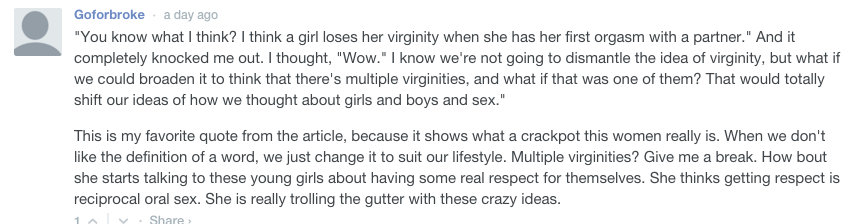
-Show NPR comments, then refute them w sources

"People need to be a little patient. Eventually teens will grow up and discover female sexuality on their own"
  • What about now? Forget the future, teens need to learn now about the importance of communication and equality during intimate times, in order to avoid the negative consequences. 
"Sex education is fine, I was taught about diseases, pregnancy, and rape. Women have had nothing but positive messages about their sexuality for the past 30 years, these women's issues are over, this is anti male nonsense"
"these girls need to be taught about having respect for themselves, not gaining respect through reciprocation."
  • use Peggy's book, or other source to prove that girl's do not feel this way and that those topics are not the only things that need to be discussed in sex-ed. 
  • Planned Parenthood research 
  • America compared to other countries academic journal article 
  • Tie into how how America not only needs to change the sex conversation in order to move forward, but needs to talk about sex in general... that only talking about sex fosters mental health for adolescents, and also physical health and prevention of sexual health risks 

Closing: 

Touch on some main points:

    -sex is often discussed as solely a way to reproduce, or taught in school that it will give you STDs and STIs, god forbid we act like teens don't do it with other intentions... Pleasure is never spoken about, which can make teens feel ashamed and wrong in regards to engaging in sexual activities.
-Peggy's book isnt saying "go have more sex" or "im upset youre having bad sex" 
-it's about female empowerment and the psychological and physical repercussions for women if we don't teach adolescents about sex and scratch more than just the surface 


Rhetorical Analysis of Project 3

I am really excited for project 3 because I've been waiting to able to write on an issue that's near and dear to me. I know many will find it interesting, but I just hope as many will respect it. Also sorry if this is a lot to read and kind of confusing, some areas have overlapping ideas.

Some perspective: My project is going to be rooted by the book, "Girls & Sex" by Peggy Orenstein. I will be arguing that the conversation of sex, especially in regards to female sexuality, needs to change- that there needs to be a shift in concern for girls because they have been mislead and deprived, as a result of America's societal and cultural pressures and misconceptions. 

*and a quick note, because I know this gets some heated and I want to be clear, I certainly will 100% not be man-hating or man-blaming in my project because that is not where the error(s) fall(s).

  • How will you draw on any or some of the following for Project 3? Be specific about how your plans for Project 3 connect to some previous, current or burgeoning interest of your own, such as...

I have a serious passion for gender and women's studies, and all my friends can attest to that. I constantly talk about issues related to GWS, and I seriously do not go a day without talking to my friends about one of them. Women's rights issues and sexuality and gender issues are so prevalent in society today that there is always something new, or perhaps a debate that's been going on forever, being written or spoken about in the news and in social media. 

I have been waiting for an opportunity to voice my strong opinion on a particular issue that I think is very important for my generation and all generations to come, it deals with American culture and sexuality in the recent times. For instance, I often hear the worst stories from my friends about college hook-ups gone wrong, or that people are so uncomfortable with discussing healthy sex and sexuality; the fact that it is so taboo in America compared to the rest of the world should signal that something is not right. I truly think that there needs to be a change in the way we discuss sexuality, particularly female sexuality, with everyone, and especially adolescents because there are too many misconceptions surrounding it that result in a massive negative impact on young adults. 


  • What are the preconceptions, previously held opinions and/or potential areas for 

                personal bias that you should be aware of for Project 3? What about any of the 
                following?:

I'm very aware that I'm biased on this, I'm liberal, as is the rest of my family, but I do come from a very nice small town outside of NYC, where there are many conservatives. I am unsure in what ways I might be biased due to that upbringing, or if it will affect my argument for this project... perhaps I will need to make sure that I'm considering a broad spectrum of people (all socioeconomic classes, races, genders, etc) when arguing that the conversation of sex is transforming in 2016 and why/for what reasons, and how is it... maybe I will narrow the lens and say female sex/sexuality, so I am not reaching/making too broad of assumptions. 

But anyways, I was raised to be a very honest person, and talk very comfortably about things that might otherwise seem like more private/personal topics to some people- that's why it's hard for me to accept that my generation is lacking in communication skills, especially in regards to sex, which results in several harmful circumstances (i.e. rape culture). I need to make sure that my slant and honesty does not offend people who just happen to be more introverted, or prefer not to be open about certain things- although, I do think that these more private people need to consider the debate and realize a problem for a lot of society, even if it's not one they can relate to. 

  • How are you thinking about your audience for this project? Who are you going to make this for? Describe them.

3 target audiences: 
1. Young women, especially HS and college students
2. I want to reach young men, as well, perhaps differently.  
3. Adults, especially parents, who need to speak to their children..
so that their kids are not apart of the uninformed, or confused, or unhappy crowd of teens & adults.

I want to make sure that I'm communicating that this issue pertains to men and women, both, because young men can be just as oblivious about positive sex/communication and uninformed, but obviously the main concern is that often times people are unfamiliar with the idea of female satisfaction, or from the NPR segment where Orenstein spoke about her book:

"Author Peggy Orenstein says that when it comes to sexuality, girls today are receiving mixed messages. Girls hear that "they're supposed to be sexy, they're supposed to perform sexually for boys," Orenstein tells Fresh Air's Terry Gross, "but that their sexual pleasure is unspoken.""

I'm aware that some people do not take rape culture seriously, and think that a lot of actions taken to end rape culture are overly drastic. (people are quite upset about serenades being taken away, which are a greek life tradition, at the u of a.) However, I will make sure that I am very clear on the situations I refer to.
  • Are there any specific words, ideas or ways of arguing that will help you relate to them in this way?

What I find works when I'm talking to girls my age, who tell me really sad stories that relate to rape culture, or prove that society portrays unrealistic expectations for girls (in bed, particularly), or prove that girl's can't communicate their own desires/goals because they're caught up in how they will be perceived by people (it's either a "slut" or "prude," and the weight those labels carry), is if I steer away from talking about sex, and more-so talking about sexual identity.  I will think of that when I'm writing my essay, so my message is not lost or confused. and honestly I'm ok if my language shocks some people, this topic requires a fresh voice, as long as the message is conveyed 

  • What do you want to accomplish with Project 3? What affect do you want it to have on your intended audience? For instance:
To explain more, I am not telling my audience, "girls need to have good sexual experiences so therefore they should go do it," or something, but rather, if a girl doesn't understand sex and isn't comfortable with herself, how can she enjoy it with someone or feel good about herself -- the goal is for girls to realize that finding what they want during intimate times with someone, will help them learn and care about themselves and foster the growth of a healthier, happier, individual.

I want girls and guys to be more comfortable with themselves and each other, so no one gets hurt, or ignores important things. It is too upsetting hearing girls say things like "I just do 'it' because the guy likes it" or worse.. And I want parents to know what's going on and what's at stake for their kids.

I also want parents and kids to see this as a way to have an honest, important conversation. I know that I am lucky to have a phenomenal, honest relationship with my mom, but I know that it's hard for others, but I'm encouraging to break the barrier down. Girls tell me all the time, "wow I wish I could talk to mom about that...." so I want moms/dads to fully grasp the importance and consider changing things, because their daughters will thank them and benefit greatly.

My mom is the one who sent me the NPR segment, and her reaction is exactly what I would expect and would hope to receive by other caring parents if they read my essay:

"It changes the whole conversation for moms and girls and makes me feel bad for you guys it's not easy walking the line bet "slut" and "prude" and getting what you really want out of a relationship "

  • Once you’ve done all your research and figured out what you think about the

              controversy you’ve chosen, what still needs to be accomplished? For instance: 

  • Is there anything that still needs to be explained or pointed out to the people talking about this issue?
  • Is there anything that the people arguing about this need to be reminded of or made aware of? 
  • Are there any perspectives on the issue that still need to be expressed?
  • Are there any persons who we still need to hear from?
  • Is there any information that we still need to gather?


  • What course genre will you be writing in for Project 3?

The standard essay. 

  • What kinds of audience expectations come along with this genre, generally?
That my argument flows and is concise, but engaging with a unique voice, and structure/layout is important, too.
  • What is your history working in the genre you have selected for Project 3?
I've written essays every year for school, but I'm looking forward to not being as constrained as I was in high school-- teachers tended to have their personal expectations, couldn't be as stylistic 
  • Describe your comfort level and general feelings about the genre. How will they affect your work on Project 3?
I'm pretty comfortable with essays, sometimes my organization of paragraphs makes the essay hard to follow, or I try to jam too many ideas in and it convolutes the focus of the paper for readers.
  • What are the two most effective conventions in this genre, in your opinion? Why? Be specific.

I want my essay to be perceived as refreshing and entertaining, while remaining credible.
1. I think the style/voice is very important, so I'll focus on how my tone and my diction are working together
2. Citations (in text) will ground my essay in terms of formality/credibility

  • Are there any historical events that might impact how your audience perceives your argument or the kind of background information or evidence you need to include? 

For instance, does media reporting on any of the following involve your issue/subject for Project 3?:

 I could touch on:
-HBO show girls
-pop culture and media
-politics and education/policy or a specific place or national
            -suburban moms talking to kids vs. city parents?
-America vs. other countries (Scandinavian countries

-regressing culture? NEEDS this conversation for young women and men, and why? What will this do for America? What does it mean for future generations (rape culture, communication, positive sex, feminism, female voice, moving forward)

  • Who else is talking about this topic? Provide us with working hyperlinks to coverage of the controversy on FOUR different media outlets.
1. Economist
2. TIME
3. NY Times
4. Salon

        3.    What are the three or four major counter-arguments you’ll have to respond to, based upon what people are saying in the press/media? Be specific and cite your sources using working hyperlinks.

People who are anti-enlightening, positive sex talk or who discourage young people from exploring their sexuality:


1. Advocates of abstinence-only sex Ed 
      -Conservative voices who may claim that honest and positive sex talks could lead to increased promiscuity or sex in teens and not necessarily responsible, healthy choices.


*I was able to find counterarguments in the comments on the NPR website featuring the audio segment of Peggy orenstein and Terry Gross, discussing the new book. (NPR segment), so there must be credible articles out there disagreeing:

2. General opposing argument: General sex education helps just fine, we don't have the same issues for women as used to


3. General opposing argument: Eventually they will grow up and discover female sexuality on their own


4. General opposing argument: Changing the conversation won't change society because of the force/control social media has over adolescents (the portrayal of women and sex in the media). 


5. General opposing argument: The conversation should be more like telling girls to have respect for themselves, not that reciprocation will get them respect.


Research Report

For this blog post, I will go into detail of the sources I've found and what information I can gather for my research component of the project.


Source #1- 

Author:  Heather Weaver 
Host: Routledge: Taylor & Francis Online, http://www.tandfonline.com/ 

Heather Weaver- 
1. Florida State University
2. Hospital 


Source Audience:

The academic journal's audience is potential authority or policy makers, like school boards who can change the way sexual education is taught.


Source Purpose:

This article uses logic as a rhetorical strategy to insist that America's sex-ed policies are less effective and teaching about abstinence will not lower the risk of sexual diseases or sexual health-related issues. With the use of statistics and scientific evidence, it directly refutes the idea that sex positive education "promotes" sex, or increases sexually risky activity in adolescents. Instead, the article compares America's sex-ed policies to other countries, like France and the Netherlands who acknowledge and accept pre-marital sex, in order to show that healthy, honest sexual education is much more effective than programs that preach abstinence.

Contextual Ideas:

5 1. It aids the argument that teaching about adolescent sex openly and realistically is beneficial for teens'  health: mental and physical. 
2. It shows that America's young people have higher rates of sexually transmitted diseases and pregnancies, compared to many other places in the world who actually welcome sexuality, and don't fear the discussion of it

Source 2: 

Author: Planned Parenthood 
Host: Planned Parenthood, www.plannedparenthood.org


audience:
Parents, authority, schools, government

Purpose:

Rhetorical strategy of logic by using statistics, to show parents and authority (like school boards) the benefits of sexual education, if taught honestly, instead of disregarding the fact that sex is going to happen amongst adolescents and therefore rendering feelings of guilt or shame for teens. 

"Today, 90 percent of U.S. parents believe that sex education programs in high school should cover topics such as sexually transmitted infections including HIV, healthy relationships, birth control, and abstinence"

Contextual ideas:

1. There is more to sex education than scaring kids about pregnancies and diseases; complex, more difficult ideas of sexual consent and actually using/buying contraceptions to prevent the potential dangers are not being discussed nearly as often.

2. Teaching honestly will have a more positive effect on teens

"Studies have shown that parents have a greater impact on the sexual health of their children when family conversations about sex and sexuality are ongoing. The American Academy of Pediatrics suggests that parents have open, honest, reciprocal, and repeated conversations with their children about sexuality beginning early in their children’s lives. Repeated conversations allow parents to reinforce and build on what they want to teach their children. They also give children the chance to ask questions that help them understand and put into practice the lessons about sex and sexuality that their parents have taught them (Martino, 2008)."

Source 3:

Title: 'Girls & Sex' And The Importance Of Talking To Young Women About Pleasure
Author: NPR Staff, Fresh Air, Terry Gross- Host, executive producer of NPR, Columbia Journalist award
Host: NPR
Audience:
Young women, especially HS and college students, parents

Purpose:

Highlight the need to have frank discussions with girls so they know what to expect in intimate times, and how to advocate for themselves. Learn how to communicate and say what they want/desire

Contextual Ideas:

1. I ground my essay by using Peggy's book, "Girls & Sex", so I will mention that a new non-fiction book has surfaced that touches on this important issue in society
2.  I will quote from the book or the audio to support my argument; related to sexism or objectifying women in our society

Source 4: 

Title: The case for starting sex education in kindergarten
Author: Saskia De Melker- producer for PBS News Hour, Dickinson College, Production assistant for Voice of America
Host: PBS
Audience: Policy makers, school boards, teachers, activists

Purpose: 

Show that other countries are more advanced than America and that embracing sexuality, starting at a young age, is beneficial

Contextual ideas: 

Discussion of sex ed in schools, compare America to other countries, how teaching trust, intimacy, respect, etc, will lead to a more responsible and informed youth, they won't be ashamed or feel guilty, abstinence programs will end

Source 5:

Title: (Sex) lives of girls and women: How social media affects the way we think about sexuality
Author: Sarah Macwhirter; Assistant life editor 
Host: The Globe and Mail
Audience: Young girls, parents

Purpose: 

Blames social media for deceiving the youth and making girls live up to expectations to be "sexy"

Contextual Ideas:

One of my paragraphs in my essay will explain social media's role in the lives of young women, and how it forces girls to objectify themselves and how it plays out in the bedroom with men. Makes them sexualized by men

Source 6:
Title:
Author:
Host:
Audience:
Purpose:
Contextual Ideas: